Stand-Down & Soft-Click Policy in Affiliate Marketing

Introduction
Affiliate tracking policies are like terms and conditions: everyone agrees to them – but hardly anyone actually reads them.
Affiliate marketing is built on trust, transparency, and fair compensation. However, this is exactly where conflicts arise time and again, particularly due to voucher and cashback browser extensions. Two key rule sets designed to address these issues are the Stand-Down Policy and the Soft-Click Policy. The affiliate industry has largely agreed on these two standards.
In this article, we explain what lies behind these policies, why they are important, and how they impact advertisers and publishers. We also show how savvy affiliates deliberately exploit loopholes in the stand-down and soft-click policies – often without consequences.
The “Stand-Down” Rule in Affiliate Marketing
The stand-down policy is not a technical feature, but a compliance guideline that primarily applies to voucher and cashback add-ons such as Honey, Rakuten, Coupert, or similar browser extensions.
What does “stand down” mean in Affiliate Marketing?
“Stand down” literally means to step back.
The rule states: A browser extension must refrain from acting if a user has already reached the advertiser’s website via the affiliate link of another publisher.
How does this work in practice?
- A user clicks on an affiliate link (e.g. from a blogger, influencer, or comparison site)
- The user lands on the advertiser’s website
- The stand-down rule now applies: The voucher or cashback extension must not display a pop-up No new tracking click may be triggered The original attribution must remain intact
Purpose of the Stand-Down Policy
The stand-down rule is intended to prevent:
- Browser extensions appearing at the very last moment
- New affiliate clicks being triggered by discount pop-ups
- The original publisher’s commission being “captured”
👉 In short: The publisher who first convinced the user should receive the commission.
The “Soft-Click” Policy – a Frequent Point of Dispute
Closely related to the stand-down rule is the soft-click policy. It governs when a soft-click cookie may be set.
What is a “soft-click cookie”?
Most affiliate sales are tracked using so-called post-click cookies (also known as hard-click cookies). These track the last publisher whose link a customer clicks before converting and usually remain active for several days.
When a customer clicks a soft-click link, it does not overwrite any existing affiliate tracking cookie already set in the user’s browser.
A publisher using soft-click cookies only receives a commission if no other publisher has influenced the customer’s journey. In addition, soft-click cookies have a shorter lifespan and often expire at the end of the same browsing session.
Using soft-click cookies makes sense when certain publisher models are likely to overwrite other publishers’ tracking unfairly. Classifying these publishers as “soft click” protects attribution for other partners while still allowing cooperation.
Typical use cases for soft-click cookies
- Conversion overlays
- Browser extensions and toolbars
- Display and retargeting ads
Why are soft clicks problematic?
Soft clicks …
- Distort attribution logic
- Lead to last-click hijacking
- Disadvantage content publishers
- Create a lack of transparency for advertisers
For this reason, affiliate networks enforce strict soft-click policies that define which cookies may be overwritten by a soft click. Example of a soft-click policy from Tradedoubler:
- Post click followed by soft click: Post click wins
- Post click followed by post click: Last click wins
- Soft click followed by soft click: Last click wins
- Post view followed by soft click: Soft click wins
- Post view followed by post click: Post click wins
Stand-Down vs. Soft Click – the Difference
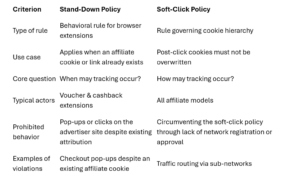
Why These Policies are Essential for Advertisers
For advertisers, missing or insufficiently controlled rules result in:
- Commissions without real added value
- Distorted performance data
- Rising costs without additional reach
Clear stand-down and soft-click rules enable advertisers to benefit from:
✅ Fair channel evaluation ✅ Clean attribution ✅ Stronger publisher relationships ✅ Higher marketing efficiency
Typical Violations of Soft-Click and Stand-Down Rules
In theory, soft-click and stand-down rules are clearly defined. In practice, however, violations are often subtle and difficult to detect without technical monitoring.
Common patterns in affiliate marketing include:
- Automatically triggered affiliate clicks without deliberate user interaction
- Voucher or cashback pop-ups appearing only in the cart or checkout and overwriting existing attribution
- Overlay elements where closing or loading the page already triggers a tracking click
- Preselected voucher activations without explicit user consent
- Ignoring the stand-down rule despite an existing affiliate cookie
- Invisible background tracking via scripts or extensions
- Circumvention of soft-click rules by routing traffic through sub-networks, comparison sites, or voucher pages – leaving the network to see only the final click
A Practical Example
In the following example, a browser extension appears during checkout even though a cookie from another affiliate has already been set.
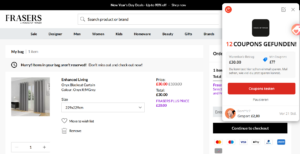
Before the customer can complete the purchase, a layer displaying 12 voucher codes appears. As soon as the customer clicks “Test,” a Coupert cookie is set.
The advertiser loses part of their margin, even though the customer was already ready to buy. At the same time, the cookie of the affiliate who originally generated the traffic is overwritten.
These mechanisms may appear harmless at first glance, but they lead to systematic attribution distortion – resulting in unnecessary costs for advertisers and disadvantaging high-quality content publishers.
Conclusion: Affiliates Follow the Rules – On Their Honor
On paper, the rules are clear: No tracking without deliberate user action. No automatic clicks. No hidden attribution.
In reality, many advertisers rely on one thing only: the affiliate honor system.
Whether a click actually resulted from an active user decision – or from an overlay, an automatically displayed voucher window, or a “creatively interpreted” trigger – remains invisible without technical monitoring. Violations of soft-click rules are rarely obvious, yet widespread.
This is the core issue: Compliance is not based on trust, but on verifiability. Anyone relying solely on policies and assurances risks paying for clicks and conversions that provide no real value.
AdPolice turns “affiliate honor” into verifiable reality – and assumptions into hard evidence. Test AdPolice browser extension monitoring now and bring true transparency to your affiliate marketing.